100+ Number Riddles For Kids With Answers
Numbers are part of everyday life. Kids use them to count toys, share snacks, play games, check the time, and learn math at school. Solving these Number riddles gives children an enjoyable way to practise number recognition, improve mental maths, and develop logical thinking. Parents can bring number riddles out on a rainy afternoon, teachers can try them as lesson warm-ups, and kids can take turns being the riddle master with friends.
Number riddles for kids combine fun questions with simple mathematical ideas. This collection of 100+ number riddles for kids with answers includes easy counting questions, funny number jokes, challenging maths puzzles, and logic-based brain teasers. Some are quick warm-ups, while others ask young thinkers to slow down and look at numbers in a different way. Pick a number riddle, read each clue carefully, and take your best guess.
Read more: Math Riddles for Kids
Number Riddles For Kids
Number riddles for kids turn math practice into a guessing game. These number puzzles suit children learning to count, recognize numbers, and do simple calculations. They use everyday examples involving buttons, weeks, shapes, and other things children already know. Younger kids can solve them with their fingers, while older children can try to work out the answers mentally.
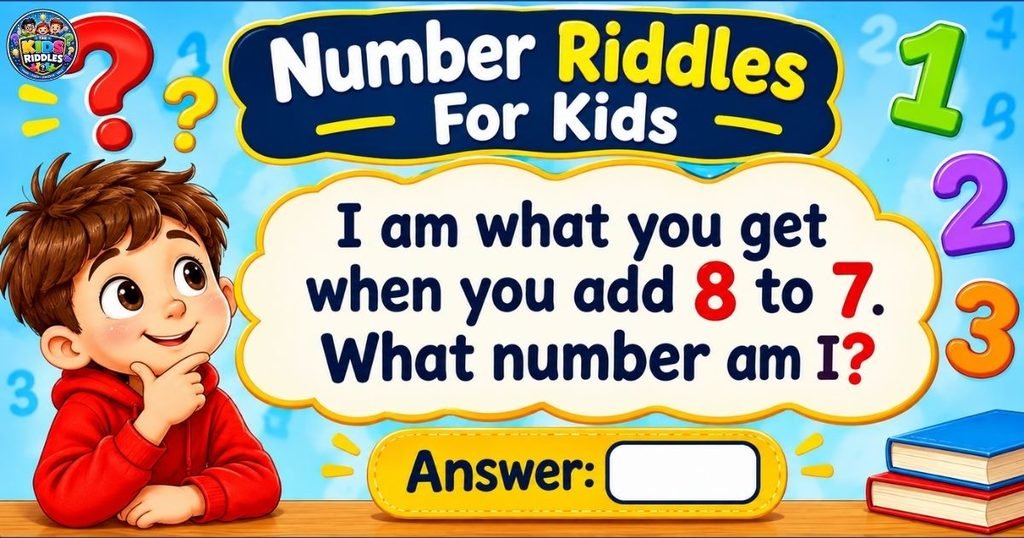
- I am what you get when you add 8 to 7. What number am I?
Answer: 15.
- A box has 3 rows with 4 buttons in each row. How many buttons are there?
Answer: 12 buttons.
- You have 5 pairs of socks. How many individual socks do you have?
Answer: 10 socks.
- How many corners does a rectangle have?
Answer: 4 corners.
- What number is 3 more than 14?
Answer: 17.
- How many days are there in two weeks?
Answer: 14 days.
- What number comes immediately before 50?
Answer: 49.
- How many groups of ten make 100?
Answer: 10 groups.
- How many sides do a triangle and a square have altogether?
Answer: 7 sides.
- What is the total when you add 6 and 7?
Answer: 13.
Read More: Picture Riddles For Kids
Easy Number Riddles for Kids
Easy number riddles for kids make a fun mystery number activity at home or in the classroom. These questions include familiar numbers, simple counting challenges, basic arithmetic, and playful word tricks.
- What number hides right between 1 and 3?
Answer: 2.
- What number rhymes with “tree”?
Answer: Three.
- What number comes just before 1?
Answer: 0.
- What’s the biggest two-digit number you can make?
Answer: 99.
- What number looks the same when you flip it upside down?
Answer: 8.
- What can you count on every day, but never actually counts anything?
Answer: Your fingers.
- What has numbers but has nothing to do with math?
Answer: A calendar.
- What’s the easiest way to double your money?
Answer: Fold it in half.
- What’s 1 + 1 if you don’t think too hard about it?
Answer: 11.
- What’s full of numbers but can’t do a single math problem?
Answer: A phone book.
- If you take 2 apples from a pile of 3 apples, how many apples do you have?
Answer: 2 apples.
- A farmer has 17 sheep and all but 9 run away. How many are left?
Answer: 9 sheep.
- What weighs more: a pound of feathers or a pound of bricks?
Answer: Neither. Both weigh one pound.
- What shape has infinite lines of symmetry?
Answer: A circle.
- I am the total when all angles in a triangle gather. What am I?
Answer: 180 degrees.
- What number has 4 tens and no ones?
Answer: 40.
- How many minutes are in one hour?
Answer: 60 minutes.
- What is half of 18?
Answer: 9.
- How many minutes are in a quarter of an hour?
Answer: 15 minutes.
- How many sides does a hexagon have?
Answer: 6 sides.
Read More: English Riddles For Kids
Funny Number Riddles for Kids
Funny number riddles for kids give familiar digits some silly personalities. Let kids take turns being the riddle reader while everyone else guesses. Some questions use familiar jokes, while others play with mathematical symbols, number names, and everyday expressions. Funny number riddles for kids can hide a word trick inside a math question.
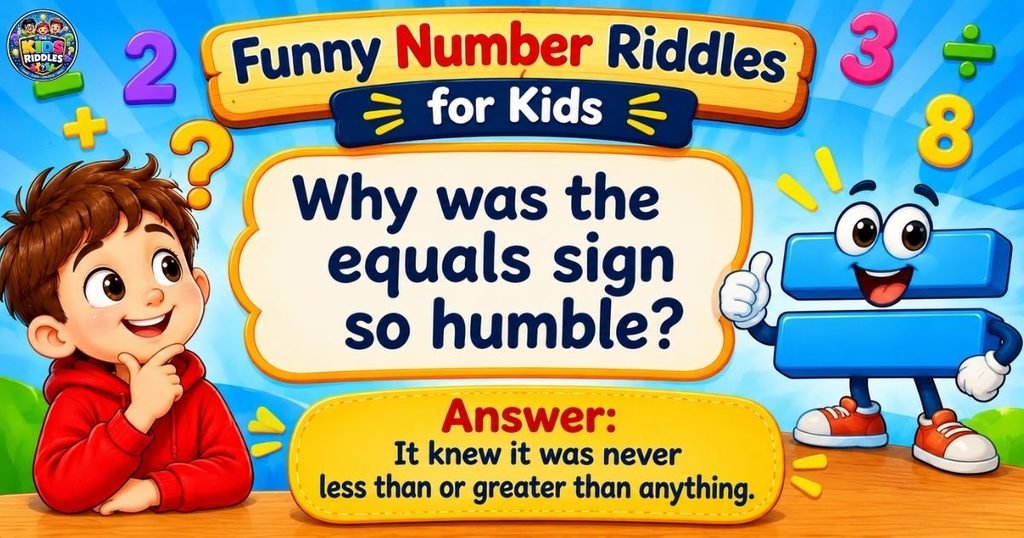
- Why was the equals sign so humble?
Answer: It knew it was never less than or greater than anything.
- Why did the student eat their math homework?
Answer: The teacher said it was a piece of cake.
- Why was the math book always so sad and stressed?
Answer: Because it had way too many problems.
- Why did zero take a ladder to mathematics class?
Answer: It wanted to reach the higher numbers.
- What did zero say to eight?
Answer: Nice belt!
- Why did four sit next to five?
Answer: It wanted to be part of a nine-to-five joke.
- Why did the fraction visit the doctor?
Answer: Its numerator and denominator were feeling divided.
- Why was 100 always so confident?
Answer: It had two zeros backing it up.
- Why did the number 10 carry an umbrella?
Answer: It was expecting a little decimal rain.
- Why did two bring a pencil to class?
Answer: It wanted to draw a pair!
Read More: Easy Riddles For Kids
Hard Number Riddles with Answers
Hard number riddles with answers turn place value into a detective game. These puzzles introduce number relationships, mathematical patterns, wordplay, and questions that require more than one step of thinking. They give kids a reason to slow down and sort through clues. These hard number riddles are useful for developing patience, careful reasoning, and confidence when facing unfamiliar mathematical challenges
- Five cats catch five mice in five minutes. How many cats catch 100 mice in 100 minutes?
Answer: Five cats.
- I am an odd number. Take away one letter, and I become even. What number am I?
Answer: Seven.
- A bat and a ball cost $1.10. The bat costs $1 more than the ball. How much is the ball?
Answer: 5 cents.
- If 5 machines make 5 gadgets in 5 minutes, how long do 100 machines need for 100 gadgets?
Answer: 5 minutes.
- What three numbers give the same result whether added or multiplied?
Answer: 1, 2, and 3.
- My tens digit is five more than my ones digit. My hundreds digit is eight less than my tens digit. What number am I?
Answer: 194.
- Divide 30 by one half and add 10. What do you get?
Answer: 70.
- How can you make seven even without addition, subtraction, multiplication, or division?
Answer: Remove the letter S from SEVEN to make EVEN.
- Two ducks are in front of a duck, two behind a duck, and one in the middle. How many ducks are there?
Answer: 3 ducks.
- In a race, you pass the runner in second place. What place are you in?
Answer: Second place.
- A number doubled is 20 more than itself. What is the number?
Answer: 20.
- How many times can you subtract 5 from 25?
Answer: Once.
- A clock loses 5 minutes every hour. After 6 hours, how far behind is it?
Answer: 30 minutes.
- A brick weighs one pound plus half a brick. How much does a brick weigh?
Answer: 2 pounds.
- A price rises 50 percent, then falls 50 percent. What happens overall?
Answer: It falls by 25 percent.
- Using four 9s and any operations, how can you make 100?
Answer: 99 + 9/9 = 100.
- Using the digits 1, 2, 3, and 4 exactly once, what is the smallest four-digit odd number you can make?
Answer: 1,243.
- What number comes next in this sequence: 2, 6, 12, 20, 30?
Answer: 42.
- A clock strikes once at 1 o’clock, twice at 2 o’clock, and so on. How many times does it strike from 1 o’clock through 6 o’clock?
Answer: 21 times.
- Using the digits 1, 2, 3, and 4 exactly once, what is the largest four-digit even number you can make?
Answer: 4,312.
Explore More: Apple Riddles For Kids
Number Riddles with Answers
Number riddles with answers invite kids to look closely, think carefully, and explain how they reached a solution. This section offers a mixture of number recognition, Roman numerals, place value, everyday measurements, and simple mathematical observations. The goal is simply to guess a number and to understand how each clue helps narrow the choices. Encourage children to read the whole number riddle before answering, then return to any words that describe size, order, or relationships between numbers.
- Which number is even and has four letters when written in English?
Answer: Four.
- How many months have at least 28 days?
Answer: 12 months.
- A two-digit number has 4 in the tens place and 7 in the ones place. What number is it?
Answer: 47.
- How many digits are there in the number 2026?
Answer: 4 digits.
- What is the place value of 6 in the number 362?
Answer: 60.
- Which number does the Roman numeral X represent?
Answer: 10.
- Which decimal number is greater: 0.8 or 0.75?
Answer: 0.8.
- What is the smallest whole number greater than zero?
Answer: 1.
- How many weeks make 21 days?
Answer: 3 weeks.
- How many zeros are there in one million?
Answer: 6 zeros.
Explore More: Science Riddles For Kids
Math Number Riddles for Kids
Math number riddles for kids invite children to combine mathematical calculations with clever questions before solving a problem. Keep the focus on understanding what the riddle says, which details matter, and how those details fit together. Before children begin calculating, encourage them to read the whole question and explain it in their own words. These mathematical riddles are suitable for older primary-school children and middle-school students who want to practise more than routine textbook exercises.
- How can you add eight 4s together so the total equals 500?
Answer: 444 + 44 + 4 + 4 + 4 = 500.
- If three workers build three tables in three hours, how many tables can six workers build in six hours?
Answer: 12 tables.
- A square has an area of 64 square units. What is its perimeter?
Answer: 32 units.
- I am a two-digit number. My digits add to 9 and reverse to make 27 more. What am I?
Answer: 36.
- If x + x + x = 42, what is x?
Answer: 14.
- A dozen eggs cost $3. How much do eight eggs cost at the same rate?
Answer: $2.
- What is 10 percent of 10 percent of 1,000?
Answer: 10.
- I am the number that is both a square and a cube greater than 1 and under 100. What am I?
Answer: 64.
- What is the smallest number that is divisible by 1, 2, 3, 4, 5, and 6?
Answer: 60.
- A group of people collects $529. If each person contributes an amount in dollars equal to the total number of people in the group, how many people are in the group?
Answer: 23 people.
- An elephant, two crocodiles, and four monkeys are weighed in pairs. The elephant and two crocodiles weigh 1,200 kg. The two crocodiles and four monkeys weigh 400 kg. The elephant and four monkeys weigh 1,000 kg. What is the individual weight of each animal?
Answer: Elephant: 900 kg, each crocodile: 150 kg, and each monkey: 25 kg.
- A farm has ducks and cows. There are 18 legs and 7 heads in total. How many ducks are there?
Answer: 5 ducks.
- A dad is 42 years old, and his son is 6. In how many years will the father be four times as old as his son?
Answer: 6 years.
- A school has 120 students. 75 play baseball, 60 play soccer, and 30 play both. How many students play neither sport?
Answer: 15 students.
- A person’s age is five times what it was 12 years ago. How old is the person now?
Answer: 15 years old.
- Two people have $100 in total. One has $40 more than the other. How much does each person have?
Answer: $30 and $70.
- A train leaves a station at 15:00 traveling at 240 km/h. Another train leaves the same station at 16:00 traveling at 360 km/h. When will the second train catch up?
Answer: 18:00.
- A person walks 3 km south and then 4 km east. What is the straight-line distance from the starting point?
Answer: 5 km.
- Bob opens a book and finds two facing page numbers that add up to 21. What do you get if you multiply the two numbers?
Answer: 110 (10 × 11).
- A cyclist travels 18 km in 1 hour and 15 minutes. What is the average speed?
Answer: 14.4 km/h.
Number Riddles for Classroom Activities
Number riddles can turn ordinary classroom moments into lively practice with reasoning and number sense at the center. For teachers, they offer a flexible activity that can fit a warm-up, transition, small-group station, or quiet challenge. Teachers can use these classroom number puzzles at the beginning of a lesson, during a revision activity, or as a short team challenge.
- A teacher has 24 crayons and shares them equally among 6 tables. How many crayons does each table receive?
Answer: 4 crayons.
- There are 28 students in a classroom. If they form pairs, how many pairs will there be?
Answer: 14 pairs.
- Five teams each earn 6 points in a classroom competition. How many points do they earn altogether?
Answer: 30 points.
- Starting at 2, you count by twos until you reach 20. How many numbers do you say?
Answer: 10 numbers.
- A teacher divides 21 students into 3 equal groups. How many students are in each group?
Answer: 7 students.
- A classroom library has 32 books. One-quarter of them are science books. How many science books are there?
Answer: 8 science books.
- A teacher has 48 cards and places 8 cards in each row. How many rows does the teacher make?
Answer: 6 rows.
- A classroom has 4 rows of 8 chairs. If 5 chairs are empty, how many students are sitting down?
Answer: 27 students.
- The school library has 36 books on a table. Students borrow 9 books. How many books remain?
Answer: 27 books.
- A teacher gives 8 pencils to each of 5 groups. How many pencils does the teacher give away?
Answer: 40 pencils.
Enjoy riddles for middleschoolers
Number Brain Teasers
Number brain teasers give children a playful way to pause, notice patterns, and think carefully about how numbers work. They often involve sequences, unusual calculations, and clues that require children to recognize a hidden rule. In a classroom, they can serve as a brief warm-up, a transition between activities, or a quiet challenge for students who finish early. Number brain teasers make mathematical thinking visible without turning practice into another worksheet. For children, they offer a chance to wonder, test an idea, and revise it.
- What comes next in this sequence: 1, 1, 2, 3, 5, 8?
Answer: 13.
- Complete the following sequence: 24, 120, 720, __?
Answer: 5,040.
- Using only addition, add eight 8s to get 1,000. What is one solution?
Answer: 888 + 88 + 8 + 8 + 8 = 1,000.
- I add six to eleven and get five. How is this correct?
Answer: It is 5 o’clock on a 12-hour clock.
- How can you make 720 using exactly six zeros and mathematical operators?
Answer: (0! + 0! + 0! + 0! + 0! + 0!)! = 720.
- What comes next in this sequence: 3, 6, 12, 24?
Answer: 48.
- Which number does not belong in this group: 4, 9, 16, 20, 25?
Answer: 20. All the others are perfect squares.
- Complete the prime number sequence: 2, 3, 5, ___?
Answer: 7.
- An alarm beeps every 12 minutes. It first beeps at 8:00 a.m. At what time does it beep for the fourth time?
Answer: 8:36 a.m.
- How many different three-digit numbers can you make using 1, 2, and 3 exactly once each?
Answer: 6 numbers.
Explore More: Escape room riddles with answers
Logic-Based Number Riddles
Logic-based number riddles help children practice careful thinking while making number work feel like a puzzle to solve. Instead of relying on quick calculation alone, students use clues, notice relationships, and explain how they reached an answer. Unlike simple arithmetic questions, these Logic-based number riddles may involve probability, wordplay, geometry, time differences, or arrangements.
- If every child in a classroom keeps both thumbs hidden behind their back, how many thumbs can you see?
Answer: 0 thumbs.
- I am a number, but when you add G to me, I go away. What number am I?
Answer: One (G + one sounds like gone).
- How can you make a two-sided polygon?
Answer: Draw it on the surface of a sphere using two lines that connect the same pair of points. This shape is called a digon.
- If you have 30 red socks, 20 white socks, and 10 blue socks, how many will you pick to get at least one matching pair without looking?
Answer: 4 socks
- Three monkeys share a bunch of bananas. The first monkey takes 3 bananas, the second takes half of the remaining bananas, and the third takes the last banana. How many bananas were in the original bunch?
Answer: 5 bananas.
- It is 23:00 on Russia’s Big Diomede Island in winter. What time is it on America’s Little Diomede Island?
Answer: 02:00 on the previous day.
- What is the smallest positive number divisible by both 6 and 8?
Answer: 24.
- A three-digit number has three different digits. Its hundreds digit is 4, its tens digit is 3, and its ones digit is 2. What is the number?
Answer: 432.
- Three consecutive whole numbers add up to 36. What are the numbers?
Answer: 11, 12, and 13.
- Four friends each shake hands with every other friend exactly once. How many handshakes take place?
Answer: 6 handshakes.
Enjoy more: Riddler Riddles For Kids
Conclusion
Number riddles for kids are a playful way to explore math while practicing careful reading, logical thinking, and persistence. Riddles about numbers encourage kids to listen closely, look for relationships, and share the thinking behind their answers. Number riddles provide an enjoyable opportunity to practise mathematics, recognize number patterns, and develop logical thinking. Parents can make these number learning activities part of family game nights or use a few questions during everyday conversations. Teachers can introduce number riddles as classroom warm-ups, group competitions, or short revision exercises. Choose a few favourite number riddles, share them with friends, and make mathematics a fun activity for everyone!
FAQs
What are number riddles?
Number riddles are questions or puzzles that use numbers, counting, mathematical operations, or numerical patterns to make a guessing game.
How do number riddles help children?
Number riddles encourage children to practise mental maths, recognize numbers, understand patterns, and solve problems.
What age group can solve number riddles?
Children aged 6–14 can enjoy number riddles. Younger children can start with simple counting and addition puzzles, while older students can try challenging mathematical problems and brain teasers.
How can teachers use number riddles in classrooms?
Teachers can use number riddles as lesson warm-ups, group competitions, homework activities, or mathematics revision exercises.
Are number riddles useful for developing mathematical skills?
Yes. Number riddles give children opportunities to practise addition, subtraction, multiplication, division, fractions, number patterns, and mathematical reasoning.
Do the number riddles include answers?
Yes. Answers are included so kids can check their guesses and explore how a puzzle works.