155+ Best Medical Riddles for Kids That Make Healthcare Fun In 2026
Why do kids love puzzles? Because they challenge the mind while making learning fun! In our fast-paced world, it’s essential to engage children in health topics, and medical riddles provide the perfect blend of education and entertainment. Medical riddles distill complex medical concepts into simple scenarios, pushing kids to apply their understanding in creative ways.
Medical riddles serve as a creative tool to achieve this, blending humor and knowledge seamlessly. This article offers over 155 fun and educational medical riddles that will captivate your child’s interest and encourage them to think critically about health.
Read More: 140+ Best Tree Riddles For Kids
Medical Riddles for Kids
Medical riddles for kids serve as a fun bridge between learning and play. They ignite curiosity about the human body and how it works. This interactive approach can ignite a lifelong interest in health and science. Kids learn to analyze clues, make connections, and find solutions. When they solve these medical riddles, they not only grasp medical concepts but also develop confidence in their problem-solving abilities.
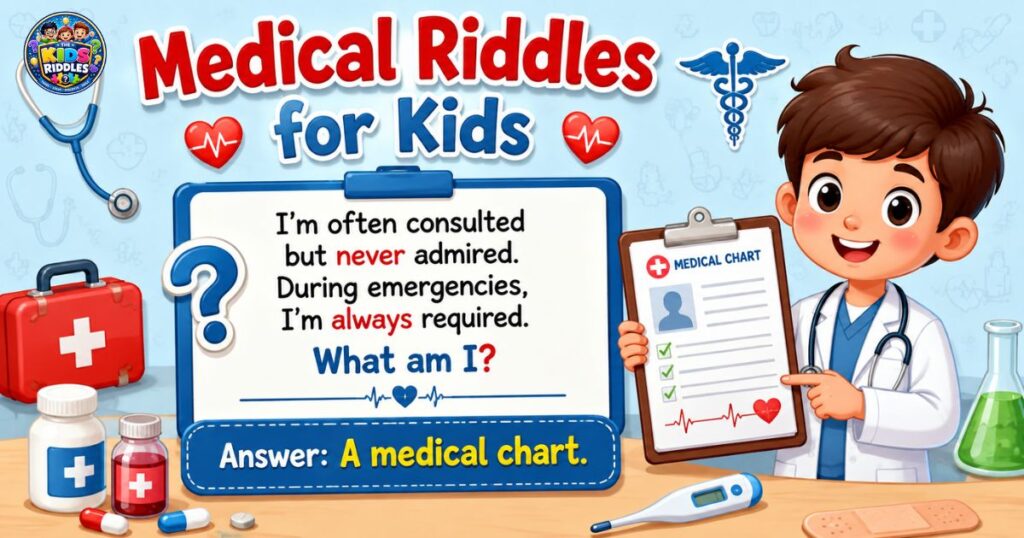
I’m often consulted but never admired. During emergencies, I’m always required. What am I?
Answer: A medical chart.
- I’m your best guess, based on signs. You confirm with labs and patient lines. What am I?
Answer: A Clinical impression.
- I’m a red flag doctors never miss. Sudden chest pain? I might be this. What am I?
Answer: A Heart attack.
- You write me down in careful lines. I track the patient’s changing signs. What am I?
Answer: A progress note.
- I check your temp, but I’m not hot. I beep when I know your fever or not. What am I?
Answer: A Thermometer.
- I’m worn around the neck, and my job is to listen. What am I?
Answer: Stethoscope.
- I can tell if you’re hot or cold, but I’m not a weather forecaster. What am I?
Answer: Thermometer.
- I’m often heard, sometimes not; my rhythm matters a lot.
Answer: Heartbeat
- I’m round and clear, worn to see far and near. What am I?
Answer: Glasses.
- Though I don’t have a brain, I’m used to scanning one. What am I?
Answer: An MRI machine.
- I appear before you, scrubbed in. Without me, infection may begin. What am I?
Answer: Hand sanitizer.
- I’m used to surgery, but I’m not a tool. I help you sleep like a fool. What am I?
Answer: Anesthesia.
- I’m a patient’s data keeper, online and neat. I help you chart without skipping a beat. What am I?
Answer: Electronic Health Record (EHR).
- You took an oath that includes me. What am I?
Answer: The Hippocratic Oath.
- I’m not a house, but I have many residents. What am I?
Answer: A hospital.
- I’m the body’s control center; without me, you’d stumble and fall.
Answer: Brain
- I’m often checked, always growing, a sign of health, as children are growing.
Answer: Height/Weight
- I listen to your heart but don’t have ears. What am I?
Answer: A Stethoscope.
- I’m found in every hospital but never get sick. What am I?
Answer: A Thermometer.
- I’m used to holding, snipping, or pinching, and in surgery, I’m a cinch. What am I?
Answer: Forceps.
- I take your blood and tell your tale, but I’m no fortune teller. What am I?
Answer: A Lab test.
- I keep you steady on your feet when your bones don’t want to meet. What am I?
Answer: A Crutch.
- I come in white, help you heal, and cover your wound with an ideal seal. What am I?
Answer: A Bandage.
- I go inside you, but I’m not food. I tell the doc what’s wrong with you. What am I?
Answer: An Endoscope.
- You can’t live without me, but if I stop, you’re done. What am I?
Answer: Your heart.
Read More: 110+ Birthday Riddles For Kids
Best Medical Riddles for Kids
Riddles can ignite curiosity in young minds, especially when they blend fun with learning about health. The best medical riddles for kids do more than entertain; they introduce important concepts. Engaging kids with these medical riddles fosters a deeper understanding of how their bodies work. Using riddles in everyday conversations can lay the foundation for lifelong health awareness.
- I’m not a mirror, but I show what’s inside. I scan your body far and wide. What am I?
Answer: A CT scan.
- I can run but never walk, have a mouth but never talk, have a head but never weep, have a bed but never sleep. What am I?
Answer: A river (used in medical analogies for blood flow).
- The more you take away from me, the larger I become. What am I?
Answer: A hole (as in surgery).
- I travel through veins, but I’m not blood. I can knock you out, but I’m not a boxer. What am I?
Answer: Anesthesia.
- I’m high when you’re healthy and low when you’re not. What am I?
Answer: White blood cell count.
- You see me every day but can never touch me. If I disappear, it’s an emergency. What am I?
Answer: Your reflection (used in neurological tests).
- I’m given by injection, but I’m not medicine. I prevent illness, but I don’t exercise. What am I?
Answer: A Vaccine.
- I get bigger when stimulated and smaller when relaxed. I control how much light enters. What am I?
Answer: The pupil of the eye.
- I’m found in hospitals, have a very important job, but I’m not a doctor or nurse. Sometimes I’m on wheels, sometimes I’m not. What am I?
Answer: A gurney/stretcher.
- I’m a vessel that carries things away, not toward the heart. What am I?
Answer: A vein.
- I’m shaped like a spoon, but I check your throat. I help your doctor take a note. What am I?
Answer: A Tongue depressor.
- You wear me when you’re sick or scared, and I go over your face when germs are shared. What am I?
Answer: A Face mask.
- I roll through the halls and help you sit. If you can’t walk, I’m a perfect fit. What am I?
Answer: A Wheelchair.
- I’m tiny and sharp, but I’m here to protect. One quick poke, and health you’ll collect. What am I?
Answer: A Vaccine.
- I’m not candy, but I come in a wrap. I go on your cut—no need to clap! What am I?
Answer: A Bandage.
- I carry your food on a little tray, and I make sure you eat at the hospital each day. What am I?
Answer: A Meal cart.
- I shine a light, but I’m not the sun. I help your doctor check what’s wrong. What am I?
Answer: A Penlight.
- You sit on me during check-ups, that’s true. I help your doctor examine you. What am I?
Answer: An Exam table.
- I’m full of buttons and go beep-beep. I help your heart when you’re fast asleep. What am I?
Answer: A Heart monitor.
- I wear a coat but not for cold. I help people heal—young and old. What am I?
Answer: A Doctor.
- I’m not magic, but I make boo-boos fade. I’m rubbed on your skin and quickly aid. What am I?
Answer: An Ointment.
- I take your blood without a bite. I’m small and quick, but not a fright! What am I?
Answer: A Finger prick.
- I sit on your arm and give a squeeze. I check your pressure with gentle ease. What am I?
Answer: A Blood pressure cuff.
- I’m not a detective, but I solve clues. I find diseases that leave no bruise. What am I?
Answer: A Diagnosis.
- You call me when the cause is tough. I list the options when symptoms get rough. What am I?
Answer: A differential diagnosis.
Explore More: 140+ Best Animal Riddles For Kids
Medical Riddles for Kids About the Human Body
Medical riddles for kids about the human body spark curiosity and boost learning. When kids try to solve these medical riddles, they explore how their bodies work. By sharing these light-hearted challenges, parents and teachers can turn everyday moments into exciting learning adventures, making kids eager to discover more about their own amazing bodies.
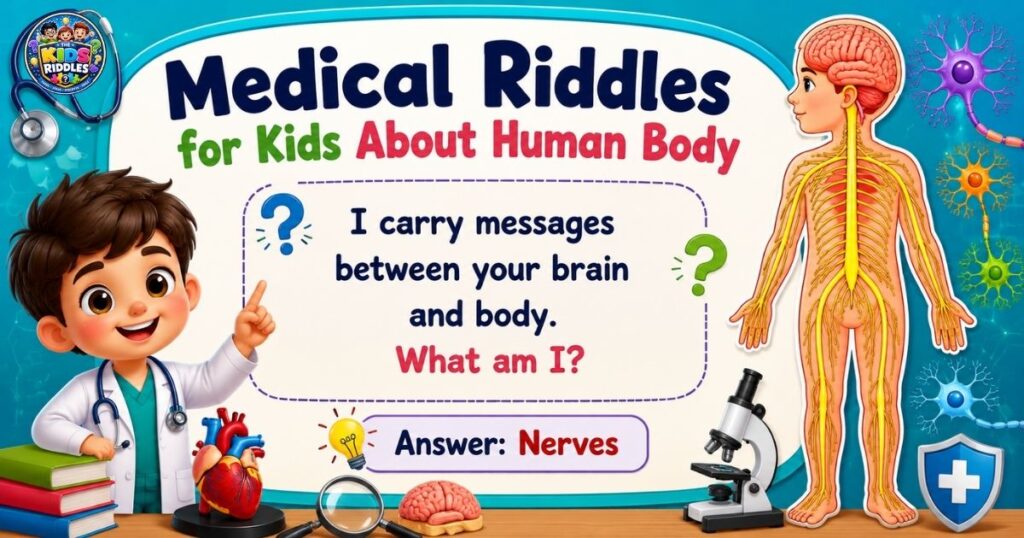
- I carry messages between your brain and body. What am I?
Answer: Nerves
- I am always growing, but only in certain parts of your body. What am I?
Answer: Hair
- I protect your joints and make movement smooth. What am I?
Answer: Cartilage
- I am a tube that carries food to your stomach. What am I?
Answer: Esophagus
- I can break, but I help you walk and run. What am I?
Answer: Bones
- I fight germs and keep you healthy. What am I?
Answer: Immune system
- I am the red part in your blood that carries oxygen. What am I?
Answer: Red blood cells
- I am the hardest substance in your body. What am I?
Answer: Tooth enamel
- I pump all day but never get tired. What am I?
Answer: Heart
- I am soft, I am pink, and I help you think. What am I?
Answer: Brain
- I have bones but no skeleton. What am I?
Answer: Hands
- I carry oxygen all over the body. What am I?
Answer: Blood
- I help you see things around you. What am I?
Answer: Eyes
- I am full of tiny filters that clean your blood. What am I?
Answer: Kidneys
- I make your body move, yet I am not alive. What am I?
Answer: Muscles
- I am the largest organ in your body. What am I?
Answer: Skin
- I help you breathe in and out. What am I?
Answer: Lungs
- I am in your head, I protect your brain, and I am hard. What am I?
Answer: Skull
- I am the center of your nervous system. What am I?
Answer: Spinal cord
- I help you taste, and I am small and pink. What am I?
Answer: Tongue
Read More: 100+ English Riddles For Kids
Medical Riddles About Medical Discoveries
Medical riddles often serve as intriguing gateways into the world of scientific breakthroughs. Discoveries like these highlight how nature often holds the keys to our medical challenges. Exploring medical discoveries through riddles not only entertains but also educates. These playful medical questions deepen our appreciation for the journey of medical research, reminding us that behind every innovation lies a fascinating story waiting to be uncovered.
- Who performed the first successful human heart transplant in 1967?
Answer: Dr. Christiaan Barnard.
- Who revealed how blood circulates through the body in the 17th century, disproving ancient theories?
Answer: William Harvey.
- Who, in an ancient surgical text from India, describes plastic surgery techniques that are still relevant today?
Answer: The Sushruta Samhita.
- Who discovered penicillin, revolutionizing the treatment of bacterial infections?
Answer: Alexander Fleming
- Who developed the radioimmunoassay technique, enabling precise measurement of biological substances?
Answer: Rosalyn Yalow
- Who carried my lamp through dark hospital halls during the Crimean War, revolutionizing nursing practice?
Answer: Florence Nightingale.
- Who developed the first successful vaccine, using cowpox to prevent smallpox?
Answer: Edward Jenner.
- Who discovered that washing hands between autopsy work and delivering babies prevented maternal deaths?
Answer: Ignaz Semmelweis.
- Whose document, created in ancient Greece, is still recited by new doctors today as they promise to practice medicine ethically?
Answer: The Hippocratic Oath.
- What symbol with wings and snakes represents medicine, often confused with a similar-looking staff?
Answer: The Caduceus.
- Who helped discover the structure of DNA, but my contribution was not fully recognized until after my death?
Answer: Rosalind Franklin.
- Who discovered X-rays accidentally in 1895, revolutionizing medical imaging?
Answer: Wilhelm Röntgen.
Explore More: 101+ Math Riddles for Kids
Funny Medical Riddles for Kids
Kids have a knack for finding humor in the most unexpected places, and funny medical riddles are a better way to spark laughter. These brain teasers not only tickle their funny bones but also introduce young minds to the fascinating world of medicine. Sharing funny medical riddles for kids can also foster a love for learning. It’s a delightful way to blend humor and learning, crafting memorable experiences that far outlast the laughter.
- Why did the patient become a stand-up comedian?
Answer: Because laughter was the best medicine!
- Why did the brain get kicked out of med school?
Answer: Too many thoughts, not enough focus.
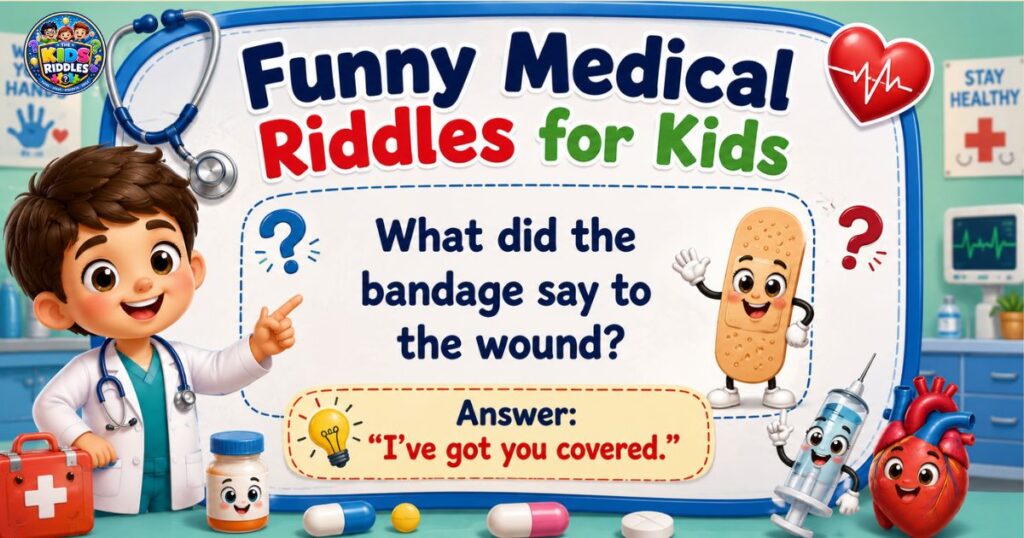
- What did the bandage say to the wound?
Answer: “I’ve got you covered.”
- Why did the white blood cell cross the road?
Answer: To get to the site of infection!
- What’s a bone’s favorite type of TV show?
Answer: A humerus comedy!
- What’s a doctor’s favorite type of music?
Answer: Hip-hop.
- Why did the surgeon always carry a notebook?
Answer: In case he had to take something down… surgically.
- What do you call a clumsy doctor?
Answer: A missed diagnosis.
- Why did the thermometer apply for a promotion?
Answer: It was tired of being stuck in the same place.
- What did the nurse say to the computer?
Answer: “Stop crashing—we have patients to chart!”
- Why do eye doctors live so long?
Answer: Because they dilate!
- What has one eye but can’t see?
Answer: A needle.
- What has a face and two hands but no arms or legs?
Answer: A clock, often found in medical settings like hospitals or clinics.)
- What medical tool is used to listen to the heart?
Answer: A Stethoscope
- What condition makes you see stars?
Answer: A concussion
- Why did the doctor put a band-aid on the computer?
Answer: It had a virus
- Why did the skeleton refuse to fight the infection?
Answer: He didn’t have the guts.
- What did the doctor say to the sleepy nurse?
Answer: “You’re losing patience!”
- Why did the stethoscope get kicked out of class?
Answer: It was caught listening in.
- Why did the doctor carry a pencil and a banana?
Answer: In case he needed to draw blood and split.
Enjoy More: 160+ Best Food Riddles For Kids
Hard Medical Riddles with Answers
Engaging with hard medical riddles sharpens critical thinking and also deepens our understanding of complex medical concepts. This exploration reveals the importance of dosage and patient adherence, showing the delicate balance in treatment plans. By tackling these hard medical riddles with answers, we not only spark curiosity but also foster a deeper appreciation for the nuances of healthcare. Each medical riddle serves as a launching pad for further exploration into the vast world of medicine.
- What type of water keeps you the healthiest?
Answer: Well water
- What’s a foolproof way to get rid of dandruff?
Answer: A close shave
- Why don’t skeletons get sick?
Answer: Because they have strong bones
- What did the germ say to the sneeze?
Answer: You blow me away
- Why did the bandage break up with the wound?
Answer: Because it felt used
- What do you call a doctor who fixes websites?
Answer: A URLologist
- Why did the thermometer go to therapy?
Answer: It had too many ups and downs
- What did the nurse say to the clock?
Answer: Time to check your pulse
- I help doctors hear deep inside to catch the sounds that patients hide.
Answer: Stethoscope
- What did the surgeon say after finishing the operation?
Answer: That’s a wrap
- Why did the patient bring a ladder to the doctor’s office?
Answer: He heard he needed to get his spirits up
- What sport is the most stressful for the brain?
Answer: Mind games
- What happens when a zebra forgets sunscreen?
Answer: It gets extra stripes
- What do you call a dentist in the army?
Answer: A drill sergeant
- What do you call a flu-stricken alligator?
Answer: A sick-o-dile
- What’s worse than losing your mind in a car accident?
Answer: Losing your body
- What should you always take after a hit-and-run?
Answer: The car’s license plate number
- What’s the best way to stop heartburn?
Answer: Stop swallowing fire
- What’s the difference between a fever and a traffic jam?
Answer: One raises your temperature, the other raises your temper
- What’s the difference between a staircase and a pill?
Answer: One is hard to climb, the other is hard to swallow
Explore More: 110+ Best Candle Riddles For Kids
Medical Riddles for Classroom Activities
Incorporating medical riddles into classroom activities can ignite curiosity and foster a deeper understanding of health and science concepts among students. These medical riddles serve not only as a fun break from traditional lessons but also encourage critical thinking and problem-solving skills. As students work together to unravel clues, they build their teamwork skills, all while making connections to real-world medical knowledge. Ultimately, this innovative approach transforms the learning environment, making medical riddles more memorable and accessible.
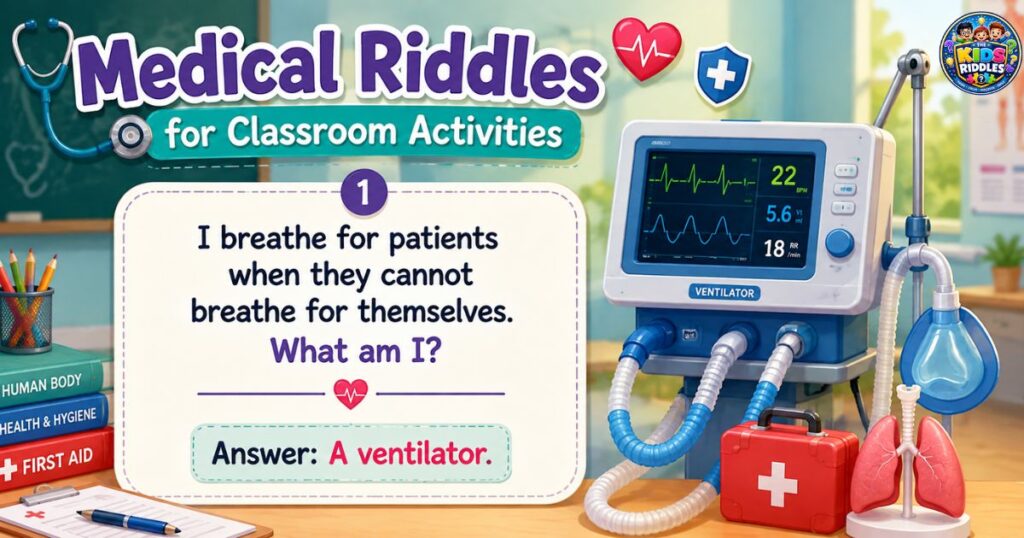
- I breathe for patients when they cannot breathe for themselves. What am I?
Answer: A ventilator.
- I’m cold and metal, letting doctors hear your heart and lungs. What am I?
Answer: A Stethoscope.
- I track your heart’s electrical activity through leads attached to your chest and limbs. What am I?
Answer: An Electrocardiogram (ECG/EKG) machine.
- I’m squeezing around your arm to measure the pressure of your blood flow. What am I?
Answer: A Sphygmomanometer (blood pressure cuff).
- Which is often used to numb the pain?
Answer: An anesthetic
- What helps diagnose conditions inside the body?
Answer: Ultrasound
- What is a sign of inflammation or infection?
Answer: Swelling
- What kind of doctor treats ducks?
Answer: A quack!
- What did the dentist say to the golfer?
Answer: “You have a hole in one!”
- What do you call a doctor who fixes websites?
Answer: A site-physician!
- What do you call someone who steals pain medication?
Answer: A paracetamol!
- I see inside you without surgery, taking pictures layer by layer. What am I?
Answer: A CT scanner.
- I magnetically align your body’s atoms to create detailed images of soft tissues. What am I?
Answer: An MRI machine.
- I’m sharp and pointed, delivering medicine beneath the skin. What am I?
Answer: A needle.
- Why did the scarecrow go to medical school?
Answer: Because he was outstanding in his field.
- What kind of tree can fit in your hand?
Answer: A palm tree!
- What’s a skeleton’s favorite musical instrument?
Answer: A Trombone!
- What did the patient say when the doctor removed his bandages?
Answer: “I’m glad that’s behind me!”
- Why don’t skeletons fight each other?
Answer: They don’t have the guts!
- What has teeth but can’t eat?
Answer: A comb.
Enjoy More: 110+ Best Thanksgiving Riddles For Kids
Medical Riddles for Adults
Medical riddles for adults challenge our understanding of anatomy, physiology, and the complexities of the human body. Moreover, solving these medical riddles can stimulate curiosity about medical conditions and treatments. When faced with a riddle that pertains to a specific ailment, adults are prompted to investigate further, perhaps leading to valuable insights or lifestyle changes. Engaging in this playful exploration can cultivate a richer understanding of our bodies and the intricate systems that keep us alive.
- I store all your thoughts, I plan and command, Yet without me, you’d lose life’s stand. What organ am I that holds knowledge so grand?
Answer: Brain
- I filter and balance, though I never shout. Too much salt, and I might give out. What organ am I that quietly cleans out?
Answer: Kidney
- I creep without pain, a slow-growing force; I strain your heart and alter its course. What condition am I that brings real harm?
Answer: High Blood Pressure (Hypertension)
- I fight the bad, but not the good. Taken too much, I’m misunderstood. What treatment am I not always using as I should?
Answer: Antibiotics
- I’m white and hard, I help you chew, I break down food, and I’m good as new. What am I finding in you?
Answer: Teeth
- I’m red and sweet, crunchy too; I keep the doctor away from you. What fruit am I that’s good to chew?
Answer: Apple
- I send signals fast, I help you feel, I’m in your body and make things real. What am I that helps you heal?
Answer: Nerve
- I’m strong and tough, I hold you high, without me, you couldn’t stand or try. What am I that helps you move?
Answer: Bone
- I’m soft but strong, I pump with care, I move blood around, everywhere. What am I beating without a scare?
Answer: Heart
- I’m a bony frame that rattles around, I make no sound, yet I’m always found. Who am I dancing underground?
Answer: Skeleton
- It makes you laugh and jump with glee, You can’t escape, not easily! What makes you squirm uncontrollably?
Answer: Tickling
- I pump all day, I never rest, inside your chest I do my best. What organ am I always the heartbeat guest of?
Answer: Heart
- I’m sharp and quick, I make you squeal, a little sting and then you heal. What am I with a pointy feel?
Answer: Injection
- I help you sniff, I help you sneeze, when something tickles or feels the breeze. What am I that gives a wheeze?
Answer: Nose
- I travel in troops, unseen to your eye, I protect your body when invaders try. What am I in the bloodstream marching by?
Answer: White Blood Cells
Enjoy More: 110+ Best Easter Riddles For Kids
Conclusion
Medical riddles for kids serve as an engaging way to introduce young minds to the fundamentals of health and wellness while also honing their critical thinking skills. These fun and educational medical puzzles spark curiosity and also foster a sense of wonder about the human body and its functions. By incorporating medical riddles into learning, parents and educators can create an enjoyable atmosphere that encourages children to explore important medical concepts. As children solve these medical riddles, they gain confidence in their knowledge and become more informed individuals.
Read More: 150+ Fun Soccer Riddles For Kids
FAQs
What Are Medical Riddles?
Medical riddles are fun puzzles based on doctors, hospitals, medicine, the human body, and healthcare that challenge your thinking while teaching useful medical concepts.
How can medical riddles help children?
Medical riddles encourage creative problem-solving, enhance vocabulary, and increase interest in healthcare topics, all while being fun!
Are the riddles based on real medical concepts?
Yes, the riddles often feature real medical terms and concepts, helping to make complex ideas more accessible to children.
Can these medical riddles spark interest in future careers?
Definitely! By introducing children to medical terminology and concepts in a fun way, you may inspire them to explore careers in healthcare later on.