151+ Fun Science Riddles For Kids To Discover In 2026
Science is more than just facts and figures; it’s a treasure trove of mysteries waiting to be revealed. Science has a playful side that often goes unnoticed, and science riddles are the perfect way to tap into this creativity. Science riddles illustrate their significance and how they bridge gaps between complex concepts and everyday understanding.
In this article, we’ll dive into the intriguing world of over 151 science riddles for kids, exploring not only the fascinating concepts they represent but also why they matter in our everyday lives. By the end, you’ll have a deeper appreciation for the interplay between science and curiosity.
Explore More: Math Riddles for Kids
Science Riddles For Kids
Engaging children in scientific inquiry can be effectively facilitated through the strategic use of science riddles. By presenting complex concepts as riddles, cognitive engagement is promoted, fostering deeper comprehension and retention of scientific knowledge. Science riddles for kids provoke critical thinking but also cultivate a curiosity about natural phenomena, thereby stimulating intellectual exploration.
Organism that produces its own food through photosynthesis or chemosynthesis. What am I?
Answer: Autotroph (producer)
Mountain formation caused by tectonic plate collision. What am I?
Answer: Orogeny (mountain building)
Property of water allowing insects to walk on its surface. What am I?
Answer: Surface tension
Planet with the most confirmed moons in the solar system. What am I?
Answer: Saturn
Energy production without oxygen used in muscles and yeast. What am I?
Answer: Anaerobic respiration (fermentation)
Bending of waves around obstacles or through openings. What am I?
Answer: Diffraction
Radioactive element used in dating ancient rocks with a billion-year half-life. What am I?
Answer: Uranium-238
Organ that filters blood and produces urine. What am I?
Answer: Kidney
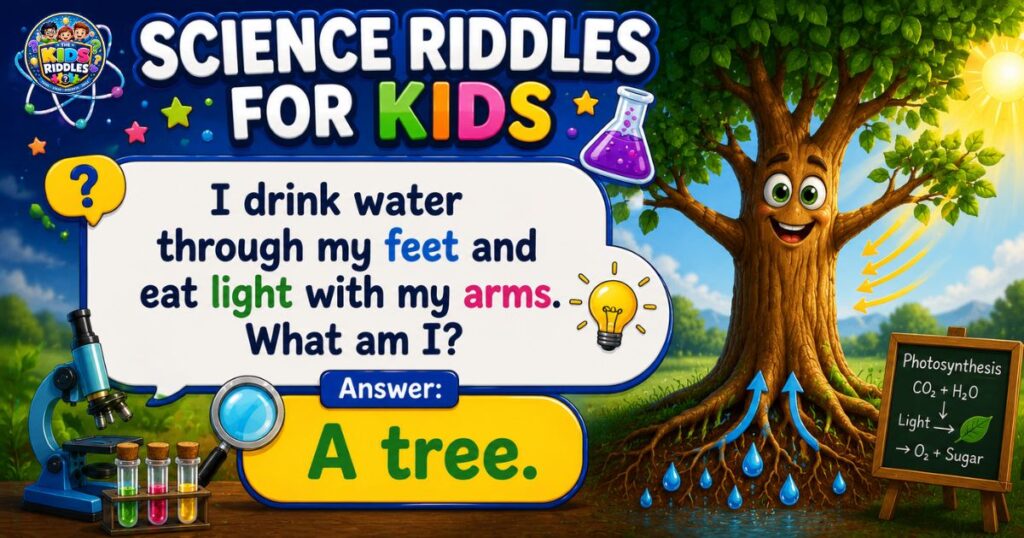
- I drink water through my feet and eat light with my arms. What am I?
Answer: A tree
- I fall from the sky, but I am not rain. I blanket the ground, but I am not a carpet. What am I?
Answer: Snow
- I have a heart that never beats, branches but no leaves, and I can be found in a chest. What am I?
Answer: A leaf vein system
- I make up more than half of your body and fall from clouds. What am I?
Answer: Water
- I carry oxygen through your blood; I am red and microscopic. What am I?
Answer: A red blood cell
- I breathe in what you breathe out and breathe out what you breathe in. What am I?
Answer: A plant
- I am always hungry and must be fed; the finger I touch turns red. What am I?
Answer: Fire
- I have no legs but travel miles every second and let you see. What am I?
Answer: Light
- I protect your brain and am very hard. What am I?
Answer: The skull
- The more you take of me, the more you leave behind. What am I?
Answer: Footprints
- I carry your genetic blueprint using four chemical letters. What am I?
Answer: DNA
- I am the powerhouse of the cell and produce energy. What am I?
Answer: Mitochondria
- I am the process plants use to make food from sunlight. What am I?
Answer: Photosynthesis
- I come in 23 pairs and determine your traits. What am I?
Answer: Chromosomes
- I control balance and coordination in your brain. What am I?
Answer: The cerebellum
- I am your body’s largest organ and protect you. What am I?
Answer: Skin
- I am a symbiosis of fungus and algae that survives extreme conditions. What am I?
Answer: Lichen
- I move water through plants and release it from leaves. What am I?
Answer: Transpiration
- I cycle nitrogen through air, soil, and living things. What am I?
Answer: The nitrogen cycle
- I surround plant cells and provide structure and protection. What am I?
Answer: The cell wall
Enjoy More: Food riddles for kids
Best Science Riddles For Kids
Science riddles are a fantastic way to spark curiosity and enhance critical thinking in kids. One of the best things about these riddles is that they seamlessly integrate learning with fun, making complex concepts feel accessible and enjoyable. By engaging with the best science riddles for kids, young minds can explore topics like biology, physics, and chemistry in a light-hearted way. Encouraging kids to share their favorite science riddles can also foster communication skills and teamwork, turning learning into a collaborative adventure.
- About 78% of Earth’s atmosphere but not directly used for breathing. What am I?
Answer: Nitrogen (N₂)
- Cooled liquid element used to maintain superconducting magnets in MRI machines. What am I?
Answer: Liquid helium
- Which weighs more, a ton of concrete or a ton of feathers?
Answer: They both weigh the same (a ton).
- What is the center of gravity?
Answer: The letter V
- Give it food, and it will live; give it water, and it will die. What is it?
Answer: Fire
- Why did the scientist take out his doorbell?
Answer: He wanted to win the no-bell prize
- What was the first animal to go into space?
Answer: The cow that jumped over the moon
- How did Ben Franklin feel after discovering electricity?
Answer: Shocked
- I can rush, be hot, be cold. I can slip through almost anything. What am I?
Answer: Water
- What can go up and come down without moving?
Answer: The temperature
- What has a foot on each side and one in the middle?
Answer: A yardstick
- What grows only upwards and can never come down?
Answer: Our height
- I am excellent to taste, but horrible to smell. What am I?
Answer: A tongue
- I touch your face. I am in your words. I am a lack of space and beloved by birds. What am I?
Answer: Air
- What breaks but never falls?
Answer: Dawn
- What falls but never breaks?
Answer: Dusk
- What has a mouth but cannot chew?
Answer: A river
- What kind of rocks are on the bottom of the Mississippi River?
Answer: Wet rocks
- What is the moon worth?
Answer: $1, because it has 4 quarters
- What do the numbers 11, 69, and 88 all have in common?
Answer: They read the same right side up and upside down.
Explore More: Escape room riddles with answers
Science Riddles With Answers
Science riddles with answers are a fun and engaging way to deepen our understanding of scientific concepts while exercising our critical thinking skills. They challenge us to think outside the box and playfully connect seemingly unrelated ideas. Science riddles can serve as an effective educational tool for all ages. They can transform a mundane classroom experience into an interactive adventure, inviting students to collaborate and brainstorm.
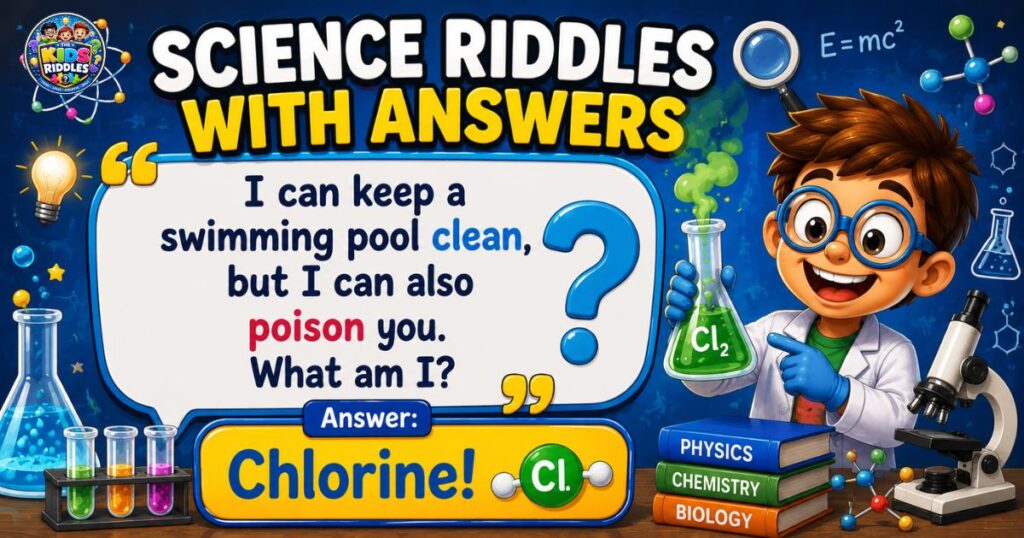
- I can keep a swimming pool clean, but I can also poison you. What am I?
Answer: Chlorine!
- I am under your face and outside your mind. What am I?
Answer: Your skull
- Why was the physics book so heavy?
Answer: Because it had a mass appeal.
- I can be cracked, made, told, and played, but I’m not a toy. What am I?
Answer: A joke
- The more I dry, the wetter I become. What am I?
Answer: A towel
- I rise but never come back down. What am I?
Answer: Age
- I move without legs and cry without eyes. What am I?
Answer: A cloud
- I carry messages from the brain to the body. What am I?
Answer: Nerves
- I am always coming down but never get hurt. What am I?
Answer: Rain
- I help you breathe, but you cannot see me. What am I?
Answer: Oxygen
- What did one earthquake say to the other?
Answer: “It’s not my fault!”
- What kind of tree can fit into your hand?
Answer: A palm tree
- How can you tell a tree is a dogwood tree?
Answer: By its bark
- What is a tornado’s favorite game to play?
Answer: Twister
- When the son of the water returns to the parent, it dies. What is it?
Answer: Ice
- What can be measured, but has no length, width, or height?
Answer: The temperature
- What is full of holes but still holds water?
Answer: A sponge.
- I help plants make food using sunlight. What am I?
Answer: Photosynthesis
- I am full of stars, planets, and galaxies. What am I?
Answer: Space
- You will find me in Mercury, Earth, Mars, and Jupiter, but not in Venus or Neptune. What am I?
Answer: The letter R
Explore More: Animal Riddles For Kids
Tricky Science Riddles With Answers
Tricky science riddles can playfully illuminate complex concepts, bridging the gap between fun and learning. With each riddle, we uncover layers of science that might otherwise seem daunting, transforming abstract ideas into relatable anecdotes. By using such science riddles with answers, we not only stimulate problem-solving skills but also nurture a deeper appreciation for the scientific wonders of our world.
- I am microscopic, single-celled, and have no nucleus.
Answer: Bacteria
- I am a bit bossy; you need me for many things, such as secreting hormones required for sexual development and promoting bone and muscle growth.
Answer: Pituitary gland
- I protect astronauts from harmful space radiation. What am I?
Answer: A space suit
- I am measured in volts and help power devices. What am I?
Answer: Electricity
- I am the hottest body in the solar system, and I keep everyone warm. Who am I?
Answer: The Sun
- I am a unit of chemical elements, but I can never be trusted. What am I?
Answer: An atom makes up everything.
- What can eat a lot of iron without getting sick?
Answer: Rust
- You are in a room with 3 monkeys. One has a banana, one has a stick, one has nothing. Which primate in the room is the smartest?
Answer: You are, because you are a primate, too.
- Why was the science teacher angry?
Answer: He was a mad scientist.
- How did the astronaut serve dinner in outer space?
Answer: On flying saucers
- What is neither water nor land?
Answer: Wetlands
- You can’t see me, but I can see you. To be more specific, I see through. What am I?
Answer: An X-ray
- What did the limestone say to the geologist?
Answer: “Don’t take me for granite!”
- Did you hear the one about a chemist who was reading a book about helium?
Answer: He couldn’t put it down
- I am a god, a planet, and I can measure heat. What am I?
Answer: Mercury
- What do you do with a dead chemist’s corpse?
Answer: You just Barium.
- I am a gas that is helpful to plants, but I cannot be bought at a gas station. What am I?
Answer: Carbon dioxide
- Number one is hydrogen. Twenty-five is manganese. Sodium is eleven. What list contains all of these?
Answer: The periodic table
- What do chemists call a benzene ring with iron atoms replacing the carbon atoms?
Answer: A ferrous wheel
- Cesium and iodine love to watch television together. What is their favorite show?
Answer: CSI. CS is the symbol for Cesium, and I is the symbol for Iodine.
Read more: Fish Riddles For Kids
Funny Science Riddles For Kids
Laughter is a powerful tool in learning, especially when it comes to science! Funny science riddles for kids make it an engaging way to introduce topics like oceanography and physics. Incorporating humor into science promotes a positive learning environment where kids feel comfortable exploring complex concepts. So, equip your little ones with a repertoire of funny science riddles, and watch as they not only giggle but also grow curious about the wonders of the universe!
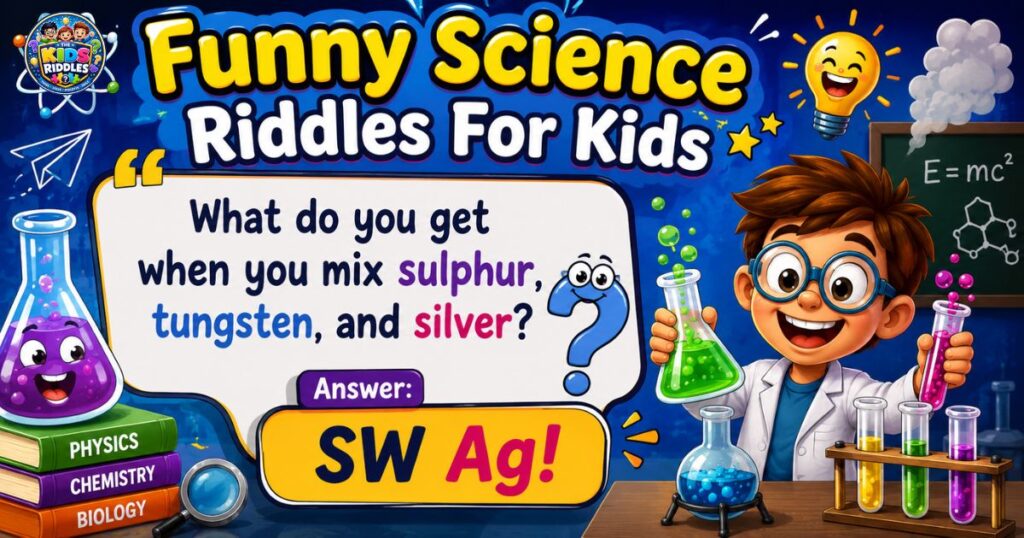
- What do you get when you mix sulphur, tungsten, and silver?
Answer: SWAg!
- What did the scientist say when he found 2 helium atoms?
Answer: HeHe.
- How do you make a tissue dance?
Answer: You put a little “boogie” in it.
- You can’t see me, but I can see you. To be more specific, I see through you. What am I?
Answer: An X-ray.
- What period of time has the least weight?
Answer: A light year!
- What did one uranium-238 nucleus say to the other?
Answer: I got to split!
- Why did the electron go to the gym?
Answer: It was looking to gain some mass!
- How did Ben Franklin feel after discovering electricity?
Answer: Shocked!
- I am full of holes but can still hold water. What am I?
Answer: A sponge!
- Why did the atom go to the doctor?
Answer: It was feeling highly unstable.
- Why did the biologist take their microscope to a party?
Answer: To make a ‘cell-fie’!
- What do you get when you cross a dentist and a computer?
Answer: A ‘byte’.
- Why did the thermometer break up with the barometer?
Answer: Too much pressure!
- I am neither water nor land. Always soaking wet, what am I?
Answer: Wetlands
- How do we know that Saturn was married more than once?
Answer: Because she has a lot of rings!
- I am an element and have a Marvel character named after me. Who am I?
Answer: Iron!
- I am a lizard but also a dragon. What am I?
Answer: Komodo dragon!
- What do computer geeks do on weekends?
Answer: They go on a disk drive!
- Which is the laziest mountain in the world?
Answer: Mt. Ever-rest!
- Before Mount Everest was discovered, which was the tallest mountain?
Answer: Mt. Everest! It was just not yet discovered.
- I wear many rings but have no fingers. Who am I?
Answer: Saturn!
- Why are you similar to Copper and Tellurium?
Answer: Because they are CuTe!
- What do you get when an unstoppable force meets an immovable object?
A paradox!
- I can flow and be still, and yet I can be hard. What am I?
Answer: Water!
- Which reindeer loves going to outer space?
Answer: Comet!
- I go around and around the wood but never into the wood. What am I?
Answer: The bark of a tree.
- Why did the computer go to the doctor?
Answer: Because it had a virus!
- What four periodic elements, when combined, terrify criminals?
Answer: Carbon, Oxygen, Phosphorus, and Sulphur (C+O+P+S)
- What is at the center of gravity?
Answer: The letter ‘V’!
- Why are chemists excellent at solving problems?
Answer: Because they have all the solutions.
Read More: 100+ English Riddles For Kids
Science Riddles For Teens
Science riddles for teens can serve as a unique bridge between curiosity and critical thinking, making learning both fun and engaging. These science riddles encapsulate fundamental ideas about physics, sparking intrigue and pushing teens to delve deeper into the science of light and energy.
- What is the chemical symbol for gold?
Answer: Au.
- What common kitchen item is made from sodium bicarbonate?
Answer: Baking soda.
- I am a colorless, odorless gas used in balloons to make them float. What am I?
Answer: Helium.
- What element is a key component of the Earth’s atmosphere and is necessary for combustion?
Answer: Oxygen.
- What is the lightest and most abundant element in the universe?
Answer: Hydrogen.
- I can be found in you; I’ma blue metal. What am I?
Answer: Copper.
- What happens when you combine sodium with chlorine?
Answer: Table salt (sodium chloride).
- It can be used to kill bacteria and also to whiten clothes. What am I?
Answer: Bleach.
- What element helps you shine in the dark?
Answer: Phosphorus.
- I can power a light bulb and also be used to make a bomb. What am I?
Answer: Uranium.
- What is the most abundant element in the universe?
Answer: Hydrogen.
- What is a common substance that is made from the combination of two dangerous elements, sodium and chlorine?
Answer: Table salt.
- What is H2O more commonly known as?
Answer: Water.
- I am a compound made of oxygen and hydrogen, but I’m not water. What am I?
Answer: Hydrogen peroxide (H2O2).
- What gas do plants absorb from the atmosphere?
Answer: Carbon dioxide.
- What element is named after the Greek word for green?
Answer: Chlorine.
- I am the most electronegative element. What am I?
Answer: Fluorine.
- What element is the primary component of diamonds?
Answer: Carbon.
- What is the only metal that is liquid at room temperature?
Answer: Mercury.
- I am made of two elements and can make your soda fizzy. What am I?
Answer: Carbon dioxide.
- What gas is essential for human respiration?
Answer: Oxygen.
- What element is known for its use in pencils?
Answer: Graphite (Carbon).
Read more: Basketball riddles with answers
Science Riddles For Adults
Science riddles for adults serve as a delightful intersection between amusement and intellectual stimulation, encouraging minds of all ages to engage with the wonders of the natural world. Science riddles challenge our understanding of concepts, inviting us to think critically and creatively. Each science riddle transforms a simple question into a profound exploration of scientific principles.
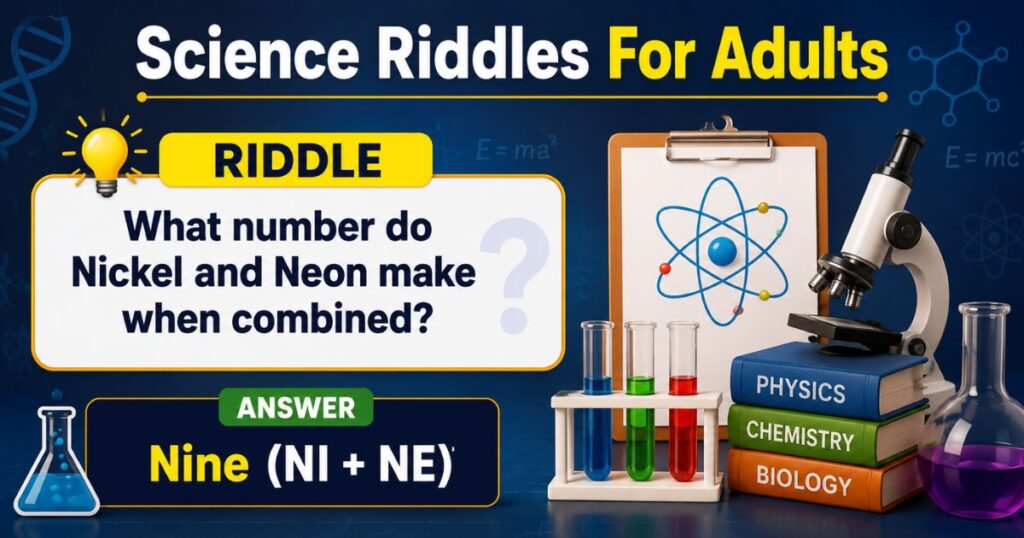
- What number do Nickel and Neon make when combined?
Answer: Nine (NI + NE)
- You cannot see me, I cannot be touched, you cannot feel me, but I can cook your lunch.
Answer: A microwave particle
- What scientist is the least interesting to listen to?
Answer: Niels Bohr
- I describe the disorder or randomness in a system. What am I?
Answer: Entropy
- Your mom and dad each gave you 23 of these threadlike strands, and they helped to make you who you are.
Answer: Chromosomes
- What two periodic elements, when combined, heal?
Answer: Helium and Aluminum (HE + AL)
- When two light nuclei become one, I liberate quite a bit of nuclear energy. What am I?
Answer: Nuclear fusion
- What is the most uninteresting of all the periodic elements?
Answer: Boron
- I was once a massive old star, and soon I will be a brightly colored gas cloud, but for now, I am a massive explosion. What am I called?
Answer: Supernova
- What are the only two periodic elements that have the liquid state?
Answer: Mercury and Bromine
- I make up about three-fourths of all the universe, and almost nothing is known about me. What am I?
Answer: Dark energy
- I am a hypothetical tunnel, a shortcut if you will, of space-time which connects faraway regions. I am a what?
Answer: A wormhole
- I was once called an embryo, but I have now gone through more than eight weeks of development, so my name has now changed to what?
Answer: A fetus
- What kind of chemical element hates to be a follower?
Answer: Lead
- I am a black hole’s equivalent of a one-way street. What am I?
Answer: The event horizon (a boundary in which nothing can ever leave, only get pulled in)
- What is black when you buy it, red when you use it, and gray when you throw it away?
Answer: Charcoal
- What is the loneliest of all physics concepts?
Answer: The singularity
- What element is derived from a Norse god?
Answer: Thorium
- I am the toe that every scientist would love to have as their own, yet there has never been a single person who has had a toe that everyone agreed was the best. What kind of toe am I?
Answer: Theory of everything (also called a TOE in the scientific community)
- H, Be, F, S, Mn, Kr, In, Gd, and Tl? What’s the next in the sequence?
Answer: Fm. These are the chemical elements whose atomic numbers are perfect squares.
Read More: 110+ Birthday Riddles For Kids
Conclusion
Engaging kids with science riddles helps enhance their thinking skills about the world and also fosters a love for learning. These fun and intriguing science puzzles spark curiosity, encouraging young minds to explore the wonders of science enjoyably. Incorporating science riddles into kids’ daily routine, parents and educators can create a lively atmosphere for scientific problems. By regularly challenging kids with these science riddles, you can cultivate a lifelong passion for exploration.
See More: 110+ Clever Dog Riddles For Kids
FAQs
What are science riddles?
Science riddles are fun puzzles based on different subjects related to daily scientific things and the environment for kids to increase their knowledge.
What age group are the science riddles suitable for?
Science riddles are designed for kids of all ages, but adults who love to think can also enjoy them!
How do science riddles benefit my child?
They boost critical thinking, enhance problem-solving skills, and make learning fun by mixing knowledge with creativity.
Are the riddles themed around specific science topics?
Yes, we have science riddles covering everything from general daily routine to biology, chemistry, and physics, ensuring a comprehensive science experience!