101+ Clever Math Riddles for Kids to Think Fast In 2026
Math riddles can turn numbers into an adventure. Solving math riddles can boost your child’s problem-solving skills. As we head into 2026, fostering a love for math is more crucial than ever. In this article, we’ll introduce you to over 100 clever math riddles that are not only fun but will also challenge your kids to think fast.
By diving into these engaging math challenges, your child will not only improve their math skills but also learn to think creatively. Get ready to engage their minds and watch their confidence in math grow!
Read More: 100+ English Riddles For Kids
Math Riddles For Kids
Math riddles for kids spark curiosity and challenge young minds to think critically while also honing their problem-solving skills. These brain-teasers serve as a bridge between play and education, making math feel less daunting. Parents and educators can use math riddles during family game nights or classroom activities.
- I am a three-digit number. My second digit is four times bigger than the third digit. My first digit is three less than my second digit. Who am I?
Answer:141
- There are nine oranges, and you take away three of them. How many oranges do you have?
Answer: Three
- A 300 ft. train is travelling 300 ft. per minute and must travel through a 300 ft. long tunnel. How long will it take the train to travel through the tunnel?
Answer: 2 minutes
- What is the maximum number of times you can subtract five from 25?
Answer: Once because it becomes 20
- There are 6 apples on the table. If you take 2 away, how many apples do you have?
Answer: 2 apples.
- A grandfather, 2 fathers, and 2 sons went to the zoo together, and each person bought a ticket. How many tickets did they buy in total?
Answer: 3 tickets
- What can you put between 3 and 7 to make a number larger than 3 but smaller than 7?
Answer: A decimal point (3.7)
- A family has 5 sons. Each son has a sister. How many children are in the family?
Answer: 6 children
- How many 9s are there between 1 and 100?
Answer: 20 (9, 19, 29, 39, 49, 59, 69, 79, 89, 90, 91, 92, 93, 94, 95, 96, 97, 98, and 99)
- How do you make 1,000 only using addition and the number 8?
Answer: 888 + 88 + 8 + 8 + 8 = 1,000
- I am a 3-digit number. My second digit is four times bigger than my first and last digit. My first digit is three less than my second digit. What am I?
Answer: 141
- What are 3 positive numbers that, when added or multiplied together, yield the same result?
Answer: 1, 2, and 3
- How can you write a correct math equation only using 2, 3, 4, and 5 and addition?
Answer: 2 + 5 = 3 + 4
- If you divide 30 by ½ and then add 5, what is the result?
Answer: 65
- Mr Bowel has four daughters, and each of those daughters has one brother. How many children does Mr Bowel have?
Answer: Five children
Read More: 140+ Best Tree Riddles For Kids
Math Riddles For Grade 1
Math riddles for grade 1 are a fun way to encourage young minds to think critically while using basic math skills. Incorporating math riddles into daily routines can transform mundane math practice into an adventure. As children solve riddles, they develop problem-solving skills and boost their confidence. Try sharing riddles during snack time or before bedtime; the simple format makes it easy to weave into any activity.
- What is 2 + 1?
Answer: 3
- If you have 4 candies and get 1 more, how many do you have?
Answer: 5
- What number comes after 7?
Answer: 8
- What shape has 3 sides?
Answer: A triangle
- What is 2 + 7?
Answer: 9
- How many legs does a dog have?
Answer: 4
- What number comes before 10?
Answer: 9
- If you eat 1 apple from 5 apples, how many are left?
Answer: 4
- What is bigger, 7 or 4?
Answer: 7
- How many fingers are on two hands?
Answer: 10
- What is 4 + 4?
Answer: 8
- How many wheels does a bicycle have?
Answer: 2
- What number comes after 8?
Answer: 9
- If you have 7 balloons and lose 3, how many are left?
Answer: 4
- What is 10 minus 5?
Answer: 5
Math Riddles With Answers
Diving into math riddles with answers can transform the way you view numbers and problem-solving. These math riddles often seem simple at first, but can twist your brain in unexpected ways. Engaging with math riddles sharpens your skills and also makes learning enjoyable. When you gather with friends or family to solve problems together, you foster a spirit of teamwork and curiosity. Embrace the challenge, and enjoy the thrill of cracking these intriguing puzzles!
- If 1=3, 2=3, 3=5, 4=4, 5=4 Then, 6=?
Answer: 3, because ‘six’ has three letters
- Sandy is 54, and her mother is 80. How many years ago was Sally’s mother times her age?
Answer: 41 years ago
- How many feet are in a mile?
Answer: 5280
- What is 1.92÷3?
Answer: 0.64
- If 72 x 96 = 6927, 58 x 87 = 7885, then 79 x 86 = ?
Answer: 6897
- Look at this series: 36, 34, 30, 28, 24, … What number should come next?
Answer: 22
- Look at this series: 22, 21, 23, 22, 24, 23, … What number should come next?
Answer: 25
- If 13 x 12 = 651 & 41 x 23 = 448, then, 24 x 22 =?
Answer: 924
- Look at this series: 53, 53, 40, 40, 27, 27, … What number should come next?
Answer: 14
- What can you put between a 6 and a 7 to make the result greater than a 6 but less than a 7?
Answer: A decimal
- Freddie painted the walls for 100 apartments. How many times did he paint 8?
Answer: 20 times.
- There are seven people at a party. They meet each other, and each of them shakes hands only once with each of the others. How many handshakes will there be in total?
Answer: 21
- What is the four-digit number in which the first digit is one-fourth of the last digit? The second digit is 6 times the first digit, and the third digit is the second digit plus 3.
Answer: 1694
- Anaya planted sunflower seeds in her back garden. Every day, the number of flowers doubles. If it takes 56 days for the flowers to fill the whole garden, how long for half?
Answer: 55
- Bobby opened a book and discovered that the sum of these two-page numbers was 22. But what do you get if you multiply these two numbers?
Answer: 10 x 12 = 120
Math Riddles For Grade 2
Math riddles for Grade 2 challenge young minds to think critically while adding a dash of excitement to their math skills. Encouraging kids to solve such math riddles helps them see numbers in a whole new light. Not only do math riddles engage students, but they also promote problem-solving abilities. Kids start to enjoy math when they crack the code of a tricky riddle. Engaging with math in playful ways transforms worksheet drudgery into an adventure filled with laughter and learning.
- What is 12 + 5?
Answer: 17
- If you have 20 candies and give away 8, how many are left?
Answer: 12
- What number comes after 39?
Answer: 40
- A triangle has 3 sides. How many sides do 2 triangles have?
Answer: 6
- What is 9 + 9?
Answer: 18
- If one week has 7 days, how many days are in 2 weeks?
Answer: 14
- What is bigger, 45 or 54?
Answer: 54
- What is 15 minus 7?
Answer: 8
- How many corners does a square have?
Answer: 4
- If you have 10 balloons and buy 10 more, how many balloons do you have now?
Answer: 20
- What is 5 × 2?
Answer: 10
- What number comes before 100?
Answer: 99
- If a toy costs 6 dollars and you buy 2 toys, how much do you pay?
Answer: 12 dollars
- How many months are there in one year?
Answer: 12
- What is half of 14?
Answer: 7
Easy Math Riddles For Kids
Math riddles are a fantastic way to spark curiosity and make learning fun for kids. These brain teasers challenge the mind and also encourage critical thinking and problem-solving skills. These easy math riddles for kids can turn a simple math session into an exciting game. Incorporating riddles into everyday learning helps kids see math in a new light.
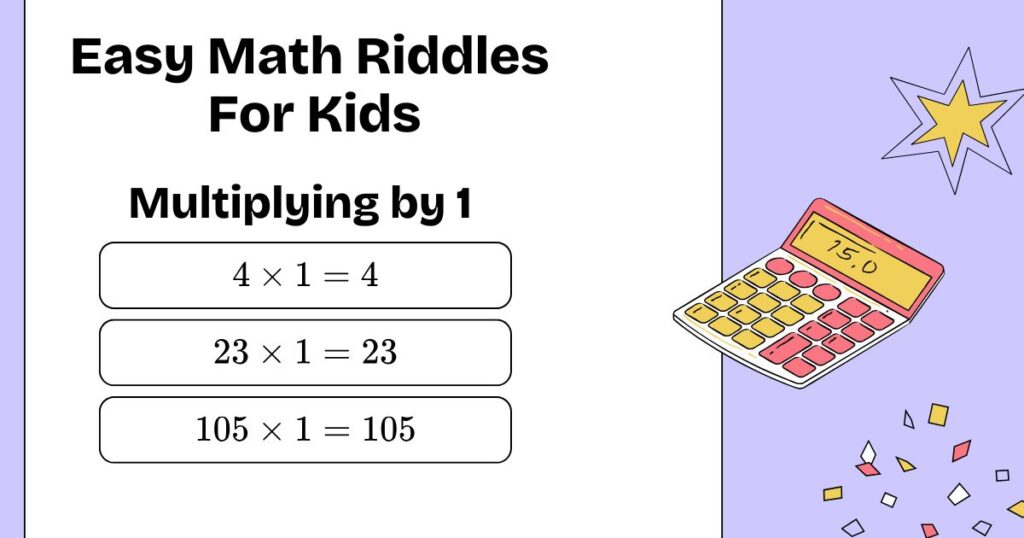
- I am an odd number. Take away one letter, and I become even. What number am I?
Answer: Seven.
- If there are 3 apples and you take away 2, how many do you have?
Answer: 2
- What comes next: 2, 4, 8, 16, __?
Answer: 32.
- Sara has 10 candies. She gives 4 to her friend. How many are left?
Answer: 6.
- What is heavier: 1 kilogram of cotton or 1 kilogram of iron?
Answer: Neither. Both weigh 1 kilogram.
- If you multiply me by any number, the answer will always remain the same. What number am I?
Answer: 0.
- A farmer has 5 cows, 2 horses, and 3 chickens. How many legs are there in total?
Answer: 28 legs.
- What number becomes smaller when you turn it upside down?
Answer: 9 becomes 6.
- What is 1 + 1?
Answer: 2.
- I have 4 legs but cannot walk. What am I?
Answer: A table.
- What comes after 5?
Answer: 6.
- If you have 3 balloons and get 2 more, how many balloons do you have?
Answer: 5.
- How many fingers are on one hand?
Answer: 5.
- If you eat 1 biscuit from 4 biscuits, how many are left?
Answer: 3.
- What number comes before 10?
Answer: 9.
Complex Math Riddles For Students
Unlocking the mysteries of complex math riddles can turn a challenging subject into an exciting adventure for students. These math riddles not only stimulate critical thinking but also foster a sense of achievement. When students tackle intricate problems, they learn to approach math creatively, transforming abstract concepts into tangible solutions. This process builds confidence and sharpens their problem-solving skills.
- What number gets bigger when you turn it upside down?
Answer: 6
- What is half of 2 plus 2?
Answer: 3
- If two’s company and three’s a crowd, what are four and five?
Answer: 9
- What is the smallest even number?
Answer: 0
- If a dozen eggs cost $3, how much does one egg cost?
Answer: 25 cents
- If there are 12 fish and half drown, how many remain?
Answer: 12
- What number is odd until you remove one letter?
Answer: Seven
- How many sides does a circle have?
Answer: Two
- If 5 cats catch 5 mice in 5 minutes, how long for 100 cats to catch 100 mice?
Answer: 5 minutes
- What is the next number: 2, 4, 8, 16,?
Answer: 32
- Which 3 numbers give the same result when added and multiplied?
Answer: 1, 2, and 3
- What is 10 divided by half plus 1?
Answer: 21
- I am a three-digit number; my digits add up to 9, and all digits are the same. What number am I?
Answer: 333
- I am an even number. Remove one letter from me, and I become odd. What number am I?
Answer: Seven
- If 2 + 2 = 44, 3 + 3 = 96, and 4 + 4 = 168, what does 5 + 5 equal?
Answer: 2,510
Hard Math Riddles For Adults
Tackling hard math riddles for adults isn’t just about crunching numbers; it’s a fun challenge that sharpens their problem-solving skills. Each math riddle pushes you to think outside the box and look at numbers in a new light. Many adults shy away from math, associating it with stress or failure. Yet, when you frame it as a game through hard math riddles, the pressure melts away. So, the next time you find yourself with a group of friends or colleagues, challenge them to solve math riddles.
- I am a three-digit number. My tens digit is five more than my one digit. My hundreds digit is eight less than my tens digit. What am I?
Answer: 194
- A quarter of the animals on a farm have 4 legs, and the other 3 quarters have 2 legs. If there are 60 legs total, how many animals are on the farm?
Answer: 24
- There are 12 students total. 6 students are wearing socks, 4 students are wearing shoes, and 3 students are wearing both. How many students are barefoot?
Answer: 5 students
- Turn me on my side, and I am everything. Cut me in half, and I am nothing. What number am I?
Answer: 8
- In an alien world, ½ of 5 equals 3. Using the same proportions, how much is ⅓ of 10?
Answer: 4
- 2 coins equal 30 cents, and one of them is not a nickel. What are the coins?
Answer: A quarter and a nickel.
- I am an odd number. Take away one letter, and I become even. What am I?
Answer: Seven (S-even)
- If you multiply me by any other number, the answer will always remain the same. What am I?
Answer: 0
- What is the next number in the sequence: 2, 4, 8, 16, 32…?
Answer: 64
- How many bricks does it take to finish a brick building?
Answer: One
- If 3 men can make 3 chairs in 3 hours, how many chairs can 6 men make in 6 hours?
Answer: 12 chairs
- I am the only number that is spelt with the same number of letters as my value.
Answer: Four
- I am a prime number. If you flip me upside down, I am still the same prime number.
Answer: 11
- Multiply me by 9, and the sum of my digits will always add up to 9.
Answer: Any single-digit number (1-9)
- I am the sum of the first three positive integers.
Answer: 6
- I am the number of degrees in a circle divided by 10.
Answer: 36
Conclusion
Math riddles are a fantastic way to make learning fun for kids. They encourage creative thinking while improving problem-solving skills. When children enjoy what they’re doing, they often learn more effectively. These fun challenges not only sharpen their math skills but also foster teamwork and communication. Moreover, solving them with friends or family can turn learning into a social activity, deepening your connections while you challenge each other. Using these math riddles at home or in the classroom can spark curiosity and excitement about math. So, gather your family or classmates and start solving some riddles about math today!
FAQs
What are math riddles?
Math riddles are fun puzzles that combine math problems with tricky questions. They make learning math exciting and challenging for kids.
How can math riddles help my child?
Math riddles boost problem-solving skills and critical thinking. They encourage kids to think creatively while having fun with numbers.
Are the riddles suitable for all ages?
Yes! We offer riddles for various age groups, from simple ones for little ones to more challenging puzzles for older kids.
How can I practice math riddles with my child?
You can read the riddles together and discuss the answers. Or, create a riddle challenge where you take turns solving them!
Do I need advanced math knowledge to understand the riddles?
No need for advanced skills! Most riddles use basic math concepts that kids learn in school, making them accessible and fun.
Can math riddles be used in the classroom?
Absolutely! Teachers can use math riddles to make lessons more engaging. They encourage teamwork and can be a great group activity.




One Comment